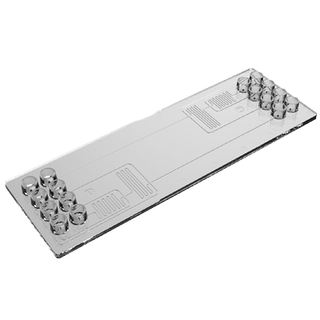
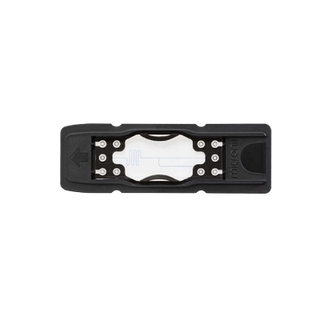
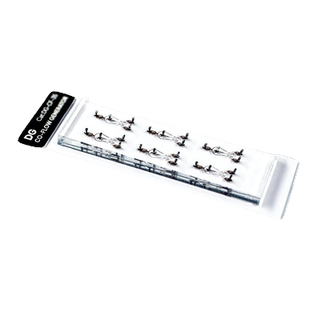
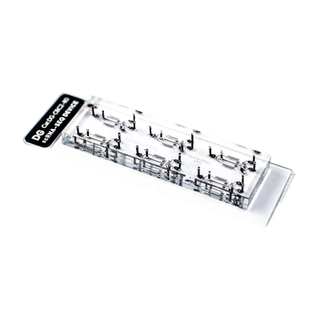
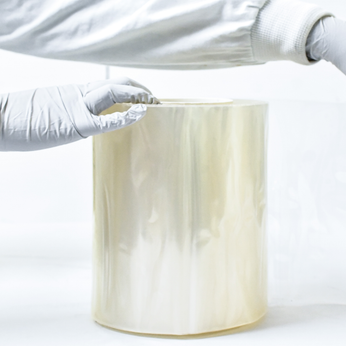
Discover this brand-new biocompatible polymer with this starter pack! The Flexdym is an excellent alternative to PDMS for microfluidic applications: self-sealing, resistant, cost-effective, and biocompatible: it will significantly ease your work when fabricating microfluidics devices.
Each kit includes 10 sheets of 15 x 15 cm Flexdym polymer.
General
Features & Benefits
A starter pack includes 10 units of 15 x 15 cm Flexdym sheets. Available thicknesses are 2.0 mm, 1.2 mm, 0.75 mm, and 0.25 mm. The Mixed pack includes 2 sheets 0.75 mm, 2 sheets of 1.2 mm, 3 sheets of 0.25 mm and 3 sheets of 2 mm. The customized pack consists of a mix of 10 sheets, allowing you to choose the thickness that best suits your needs.
The Flexdym sheets are made of a new thermoplastic elastomer tailored to combine all the advantages of PDMS without its drawbacks.
Flexdym is:
- Biocompatible (ISO 10993 parts 4, 5, 6, 10, 11 and UPS Class VI)
- Self-sealing at ambient temperature
- Cost-effective
- Compatible with optical assays: low fluorescence, optically clear
- No absorption, permeable to gas and not to liquid
- Resistant to tearing: unlike PDMS, it will not tear apart when you manipulate it.
Fast microfabrication
- Molding with a hot-embossing system
- Low pressure: below 1 bar
- No vacuum needed
- Easy unmolding
- The whole operation takes less than a minute
- Extremely low viscosity for rapid thermal molding with filling rates up to 100-1000 times greater than classical rigid thermoplastics (COC, PS, PMMA, etc.)
Applications
Flexdym is an alternative to any other chip material in the classical applications of microfluidic chips.
- 250 µm, and 750 µm are suitable and mainly used for the fabrication of membranes
- 1.2 mm and 2 mm are more straightforward to mold and suitable for Flexdym beginners in the fabrication of microfluidic chips
This polymer is particularly interesting in life sciences: its biocompatibility makes it simple to design any experiment. The self-sealing technology is not destructive, unlike plasma, vacuum, or high temperature used to seal other chips. It ensures that biological agents remain viable and functional in your device. Flexdym enables the integration of cells, proteins, enzymes, or any bio-reagents before assembly.
Optical Properties
Optical or fluorescence measurements in a chip require using materials that show a high level of transparency (almost 90% transmittance), primarily in the UV and visible range. Flexdym fulfills these conditions. Indeed, it reaches the limit of 50% transmittance (which we considered an acceptable transparency limit) at a wavelength of 295 nm. Flexdym features similar properties to the most transparent materials. This transparency window is sufficiently wide for many fluorophores, particularly the most popular fluorescent Cy3 and Cy5 dyes, which have excitation wavelengths at 550 and 650 nm and emission wavelengths at 570 and 670 nm, respectively.
Flexdym Handling
A Flexdym roll is protected by films on both sides to prevent contamination from dust or other substances. When cutting the sheet, whether using scissors or die cut, please make sure to keep the protective films on it. Remove the films before sandwiching the Flexdym sheet between the mold and counter mold.
Content
10x Sheets of Flexdym polymer (15 x 15 cm)
Specifications
Mechanical properties
| Flexdym sheet dimensions |
150 x 150 mm |
| Thickness |
250 µm
750 µm
1.20 mm
2.00 mm
|
| Hardness Shore A |
35
|
| Specific Gravity |
0.9 g/ cm3
|
| Tear Strength |
15 kN/m |
| Tensile Strength |
7.6 MPa |
| Elongation |
720 % |
| Young Modulus |
1.15 MPa |
| Melt Flow Rate ASTM D128 (190 °C / 5 kg) |
2 g / 10 min |
Thermal properties
| Operating Temperature |
-50 °C - 80 °C |
| Injection Process Temperature |
180 °C - 230 °C (Rear, Centre, Front)
20 °C - 50 °C (Mold)
|
| Embossing Process Temperature |
120 °C - 200 °C (Molding)
20 °C - 180 °C (Pre Heat)
|
Surface properties
| Advancing Contact Angle |
105° ± 4° |
| Receding Contact Angle |
88° ± 4°
|
| Contact Angle after Plasma Treatment |
< 38°
|
Resistance to solvants
| Chemicals |
Resistance |
|
Acids
|
R |
| Bases |
R |
| Fluorinated Oils |
R |
| Methanol/Ethanol |
R |
| Carboxilic Acid |
Swell |
| Hydrocarbons |
NR |
| Oil |
Swell |
Room temperature bonding
| Materials |
Time (hours) |
Burst Pressure |
| Flexdym-Flexdym |
1h |
600 mbar |
| Flexdym-Glass |
1h |
400 mbar |
Heat-assisted bonding
| Substrate |
Bonding Temperature (°C) |
Time (min) |
Bonding Strength
(burst pressure) |
| Flexdym |
80-85 |
30 |
Excellent
(5.5 bar) |
| PS, COC |
95 |
60 |
Excellent |
| PC, PMMA |
95 |
60 |
Moderate |
| Glass |
95 |
60-120 |
Moderate, non-permanent
(720 mbar) |
Documentation
Flexdym Brochure
Application Notes Flexdym Bonding
Application Notes Flexdym Connecting
Application Notes Flexdym Molding
References
- Lachaux et al., Lab on a Chip 2016, L2017 Jul 25;17(15):2581-2594. doi: 10.1039/c7lc00488e
- Perrault et al. Insights on Polymers for Microfluidics Applied to Biomedical Applications
- Overview of Materials for Microfluidic Applications, IntechOpen 2016
- Roy et al., Lab on a Chip 2015, Lab Chip, 2015,15, 406-416, doi:10.1039/C4LC00947A
FAQ
Yes, most heat presses or hot embossers should work. A press that can mold at a pressure of at least 7 psi / 0.5 bar or above is ideal (a vacuum-assisted press is not required). You may have to make minor adjustments to optimize molding your chips. We offer a user-friendly compact microfabrication kit with a plug-and-play system: Sublym.
- What size range is reliably micro-molded with Flexdym?
The minimal microchannel width is 50 nm, and the depth range is 50 nm - 1 mm. However, microchannels between 1 µm and 1 mm are recommended with an aspect ratio (height to width) of 3:1 or less. Some customers have also achieved submicron structures and higher aspect ratios.
- Which mold does Flexdym work best with?
Common molds used in the field of microfluidics work well. These include fragile molds, such as photoresists (e.g., SU‒8), and etched glass and silicon molds. Temperature-resistant epoxy and traditional metallic molds (aluminum, nickel, brass) also work. Silicones such as PDMS also work; however, choose a stiff silicone grade of at least 20 Shore A durometers above Flexdym. We offer EPMO epoxy material to fabricate robust mold suited (up to 6’’ size) for Flexdym molding without the need to treat it with an anti-sticking agent: Epoxym.
Isopropyl alcohol, methanol, or distilled water may be used. Flexdym has to be dry (air or oven-dried) before molding to avoid bubbling or splays (cloudiness). Tape is also recommended to remove dust particles. We recommend working with Flexdym in a clean room or under a laminar hood to minimize particle contamination.
- Is the Flexdym appropriate for my fluorescence applications?
Flexdym material is transparent and has a transmittance of 50% at 295 nm and > 90% in the visible region.
- How do I mold Flexdym as transparent as possible?
We recommend molding Flexdym using a very smooth mold. Metallic molds should have a mirror finish. Glass or other transparent molds, such as epoxy or other silicones, will ensure a more transparent result.
- Why do I keep getting tiny bubbles in the plastic when I mold Flexdym?
Your setup is likely too hot, or Flexdym needs to be completely dry. Lower the temperature, decrease molding time, air/oven dry Flexdym, or perform molding in a low humidity condition to minimize bubbling. It may take some trials to optimize micro molding with Flexdym on your setup.
- What is the most effective way to sterilize Flexdym?
Ethylene oxide, gamma irradiation, or autoclave will work.
- Are Flexdym microfluidic chips used for cell culture?
While Flexdym is less permeable than PDMS, it still has sufficient air permeability to sustain cell cultures. Flexdym grades have been successfully used for neurons, hepatocytes, endothelial, dermal, stem-cells, and IPSCs cell cultures. Flexdym is UPS Class VI and ISO 10993-5 biocompatible certified material (PVC, Latex, and other phthalates free).
- How do I seal Flexdym microchannels to a substrate?
Flexdym is a self-sealing material that can bond with usual microfluidics thermoplastics materials (such as PC, POC, PS, PP), glass, and Si. The bonding process does not require any plasma-assisted or UV adhesive processes. It can be bonded at room temperature. To reduce the time of bonding and/or to improve the bonding strength, a thermal bonding process can be used (maximum 95°C). Customers have successfully sealed Flexdym by binding it to a substrate and storing the chip in an oven overnight.
- How do I control the hydrophilicity of Flexdym surfaces?
In its pristine state, Flexdym is slightly hydrophobic. Strategies used on hard plastics to achieve stable hydrophilic surfaces can also be applied to Flexdym surfaces. These strategies include plasma treatment or coatings with hydrophilic materials, such as poly (vinyl alcohol), polyurethane, polyacrylate, (hydroxypropyl) methyl cellulose, polyvinylpyrrolidone, or hyaluronic acid. Multiple vendors offer hydrophilic coatings through licensing models or outsourcing. Key points to consider are the cost structure, the type of coating, the coating application (e.g., dip, spray, spin, film coats), any curing step (e.g., UV or heat), and any post-processing steps (e.g., sterilization, cleaning, or storage conditions) that may affect your final chip.
- How do I create inlet and outlet holes for my microfluidic channels?
Traditional biopsy punches used with silicones will not work here. Using a rotary/hand punch or a laser cutter is recommended. Self-sealing connection pads have been developed to ensure easy and leak-free connections with any tubing.
- How do I prevent nonspecific binding?
Methods traditionally used to treat hard plastics generally work with Flexdym as well. For example, coating the surfaces with animal caseins or BSA (bovine serum albumin) has been successfully used.